Showing posts with label flower. Show all posts

Made For The Shade

Embrace the dark side with a spectacular display of perennials perfect for those low-light spots in your landscape

When you’re made for the shade, you must gobble up every drop of sunlight. How better to do this than by unfurling broad leaves to catch the rays? 

Hosta cultivars range from those with massive leaves of green, blue or variegated to those with teensy leaves such as the whimsically named ‘Blue Mouse Ears’. All thrive with plenty of moisture in summer. They are extremely cold hardy, making them perfect for dramatic container plantings. Tubular flowers arise on tall stalks in summer some are even lily scented. These perennials die back in fall, so tuck bulbs around them for late-winter interest.

Reward each plant with a layer of compost in October and March, water deeply when summer arrives in force (with a soaker hose if time is precious) and your shade garden will shine year after year.

garden, flower, Made the shade
 Pig Squeek
Pig squeak and I didn’t make that up is the rather old-fashioned common name for Bergenia, another easy-to-grow, large-leaf perennial. Spring flowers of pink, red or white nestle among its leaves. Add Bergenia to containers for textural contrast; some cultivars have bronze foliage in winter, which is particularly eye-catching in the season’s soft light. And if you rub the leaves, guess what? They squeak!

garden, flower, Made the shade  
Bear's  breeches
Bear’s breeches (Acanthus) also shows off large, glossy leaves, along with vertical flower spikes that add height to the shade garden, an element sometimes difficult to incorporate. In mild winters, bear’s breeches is evergreen, adding winter foliage. 

garden, flower, Made the shade
Brunnera Macrophylla 'Jack Frost'
Brunnera macrophylla ‘Jack Frost’ has silver, heart-shaped leaves with green veining. In early spring it produces spraysof tiny blue flowers. Related to forget-me-nots, this hardy  perennial is much better behaved. It looks great blooming with yellow daffodils and purple hellebores. Give it plenty of compost and extra water during dry spells.

Primroses and their relatives are noted for their gorgeous flowers. In early spring you’ll seeflocks of the rainbow-hued types in garden centers and even grocery stores. I find that these little nuggets of color struggle in the garden when summer arrives. My solution is to grow a few in containers that I keep in the shade andstand in saucers of water when it gets very hot. Pampered, they reward me with blooms for months each year.

garden, flower, Made the shade
Primula Pulverlenta
For the garden, search out the less common primulas, such as the candelabra types with their twirling tiers of flowers. Of the several species in this category, I like Primula pulverulenta, its flowers come in rich tones and its stems and leaves are covered with white flecks that remind me of icing sugar. In general, species primulas are easy to grow from seed. They are sensational planted in large swathes in the filtered light of deciduous trees. Rich soil and plenty of water keeps them happy, so if you have a shady, damp area, this group of perennials is for you.

garden, flower, Made the shade
Deer fern
To create an attractive shade garden, add plants with finely cut leaves. The many species of ferns fill this role with grace and ease. I wouldn’t be without our modest B.C.-native Deer Fern (Blechnum spicant). Its long evergreen fronds are cut to the central midrib, creating a feather-like quality. A bulkier evergreen fern, our native sword fern (Polystichum munitum, matures into a substantial clump, perfect for screening a building foundation where it doesn’t mind shade and a little summer drought once established. This is just a small sampling of perennials for shade. Not only will you be amused by their wizardly names (in honour of mice, bears, pigs and deer, not to mention swords and candlesticks!), you’ll be captured by their beauty. Arrange round leaves with pointed leaves, variegated foliage with bronze, and glossy with dull for a year-round magical display.

The Kindest Cut Flowers

Roses, beautiful Roses, Beautiful Flowers, garden
The Kindest Cut Flowers - Roses
This beautiful display of roses is one of the rewards of winter pruning, along with good soil enrichment, watering and fertilizing. This cape garden features a wonderful selection of bush and climbing roses, including the tall pink ‘Queen Elizabeth’, the lower-growing floribunda ‘Bridal Pink’ and the floribunda ‘Orange Bunny’. Other roses that would produce the same effect are ‘Adele Searll’ and ‘Clever Gretel’, instead of ‘Orange Bunny’ 

Wherever roses are grown, you can be sure that winter pruning is always a major topic in magazines and newsletters, with plenty of tips and advice, dos, don'ts and details.
I recently received the newsletter from The American Rose Society, probably the largest of all rose societies, and their approach to pruning is exactly the same as ours: keep it simple, don't worry about inner or outer eyes or the angle of cuts, and, most important of all. Know "that you cannot hurt a plant, much less kill it, by 'underprunlng' or 'overpruning' it".
In California, trials were conducted over a number of years where a third of roses were pruned conventionally, another third with power hedge trimmers and the final third with hand shears in a fast shaping process.
'Year after year" reports the newsletter, 'the two fastest pruning methods yielded better results in terms of growth than the classical method". And the pruning rate was five roses a minute! Watch this space next year we'll show you how to prune your roses with power hedge trimmers!
Roses, beautiful Roses, Beautiful Flowers, garden
The Kindest Cut Flowers - Ready to Prune

ROSE PRUNING BASICS

When to prune
In most areas roses can be pruned from mid July until mid August, except in very cold areas where pruning should be delayed until mid-August.

Prune for health and neatness
For roses to thrive, cut out old, diseased or twiggy growth and clean out the centre of the plant so it has room to grow. One also prunes to neaten or shape a bush, or reduce its height or spread.

Know what you want
Light pruning results in smaller blooms in a greater quantity, and a lightly pruned bush will bloom earlier than one that has been pruned hard. Hard pruning results in fewer flowers that are larger and of better quality. Pruning can't change the nature of a rose, like turning a climber into a hybrid tea. So find out how a rose wants to grow and go with the flow when pruning It.

Don't forget the aftercare
This is even more important than the pruning. Replenishing the nutrients in the soil sets up the rose for the next season. After pruning, dig over the soil to a depth of 15-30 cm and mix In the old mulch and plenty of compost.

ROSE PRUNNING STEP-BY-STEP
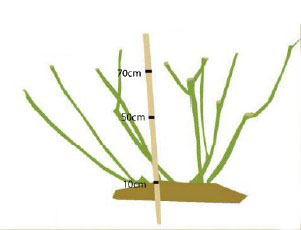
This illustrated step-by step guide gives three pruning options- light, medium and hard. Chose the option that's best for the rose, your garden or your taste. Getting ready to prune Rose varieties that benefit most from this method of pruning are hybrid teas, floribundas and the bush types of the English and nostalgia roses. Note the stick pushed in next to the rose, marked off at 50 cm and 70 cm. This makes it easy to cut the rose down to The correct height. All you need is a 1 m-long stick. From the bottom, mark off the first 10 cm. That is the depth that the stick is pushed into the ground. From the 10 cm mark, measure off 50 cm and 70 cm.

Roses, beautiful Roses, Beautiful Flowers, garden
The Kindest Cut Flowers - Step 1
Step 1 - Preparatory cut
Push the stick into the ground and cut off all the growth level with the top of the stick (which is higher than the 70 cm mark).This makes it easier to look into the bush and identify the older wood, criss-crossing stems and the past season’s basal stems that should be retained. 


Step 2 – Light pruning
Roses, beautiful Roses, Beautiful Flowers, garden
The Kindest Cut Flowers -Step 2
The  bush Is not cut down any further. Good quality basal stems are retained and old stems, as well as dead wood, are cut out at the base. Where there is a forked stem, remove one of the tines'. Thin side stems are left or can be cut back to about 20 cm. Light pruning is an option for bushes spaced well apart or where roses are growing in mixed beds and are competing for the light with other plants (herbs, annuals, small shrubs). It is essential that the pruned stems stand 50 cm above the nearby plants. This method encourages the bush to sprout quickly with smaller green leaves that provide essential food for root development. This means more hair roots and better penetration into deeper soil levels containing extra water reserves.

Roses, beautiful Roses, Beautiful Flowers, garden
The Kindest Cut Flowers - Step 3
Step 3 - Moderate pruning
For a nearer-looking, better-shaped and well-balanced bush, now reduce the length of the stems to 70 cm. Remove or shorten the remaining side stems and criss-crossing growth and reduce forks to a single tine. Moderate pruning is done if you feel that the roses need more pruning than light pruning but that hard pruning is too severe. It Is the middle ground and probably the most suitable option for most gardens. The rose will produce good quality blooms on a mixture of short and long stems.
Roses, beautiful Roses, Beautiful Flowers, garden
The Kindest Cut Flowers -Step 4
 
Step 4 - Hard Pruning

This final option selects 3-4 healthy stems and cuts these down to 50 cm above the ground, removing all remaining side stems and forks.


This option is only recommended for roses that are grown dose together, and where long, pick able stems and exhibition class blooms are required. With this pruning it is essential to:
Roses, beautiful Roses, Beautiful Flowers, garden
The Kindest Cut Flowers - Roses
Roses, beautiful Roses, Beautiful Flowers, garden
The Kindest Cut Flowers - Roses
-  The three upper eyes should sprout after pruning.
-  Correctness of upper cut is not important


Just Leave It On Top

garden, garden tools, flower, seeds
Just Leave It On Top

To mulch is to spread a layer of insulating material over the soil and around plants, to cover, decorate, prevent and project

Mulching your plants helps to save water and reduce the time you need to spend on tedious maintenance tasks like weeding.

But an added benefit of mulching with natural materials (which were in the post regarded as mere garden refuse) is that in time you will turn problematic garden soil into super soil' - nutrient-rich and easy to cultivate in, alive with aerating beneficial micro organisms, and with much better moisture-retention capabilities.

There are generally four types of mulch that one can use for different applications:
Just Leave It On Top

Organic mulches
Good examples of organic mulches are coarse compost, leaf mould, wood chips, grass cuttings and straw. These mulches should be replenished frequently as they are broken down by soil organisms like earthworms and by cultivation when the soil is prepared for new plantings. The main value of organic mulches is the continuous enhancement of the soil structure to sustain healthier plant growth - especially when dealing with day, sandy soil and surface capping.

Where to apply
The ideal places to use organic mulches are in mixed borders that are seasonally changed with spring- or summer-flowering bulbs and bedding plants, and also in mixed shrub beds that ate densely planted.

Just Leave It On Top

Inorganic mulches

Gravel, river pebbles, cut stone and colorful stone chips are examples of inorganic mulches of a more permanent nature. These materials are mostly used as a decorative layer to round off an eye-catching specimen plant or strong fecal point. The biggest advantage of a fairly thick layer of inorganic mulch is that it goes a long way to keeping the soil moist for longer, cutting out the need for frequent irrigation.

Where to apply
One would use inorganic mulching materials (some of which arc unfortunately quite expensive) in areas of the garden that have low to medium water requirements, such as a rock or succulent garden.


Just Leave It On Top


Sheet mulching
Sheet mulches such as geotextile fabric let through water and air, but create a barrier that smothers weeds by keeping them in the dark and also protect the soil from wind-borne weed seeds. They are a necessity when creating a new gravel garden that contains lots of plants, in large and newly developed flowerbeds, and in vegetable gardens where weeds such as onion weed and oxalis are a major problem. After preparing the soil well with compost and bonemeal and levelling it off prior to planting lay the mulch matting over the soil, securing the edges with stones or anchoring it with blue wire pins. When It Is time to plant simply cut a cross in the matting, plant through the hole and tuck the flaps back to fit snugly around the plant’s stem. Ordinary black plastic sheeting can also be used but is not ideal around plants use it only to oppress weeds underneath solid paving or gravelled areas without plants.

Where to lay a sheet
Use sheet mulching wherever you have never planted before, but are now planning a new flowerbed, veggie garden or hedge Geotextile fabric is a practical measure, but not o decorative one, After planting, with all your beauties cosily tucked in, you might want to hide the sheet mulch while waiting for the plants to mature. Do this with a decorative layered another type of mulch such as bark chips or bark nuggets.


Just Leave It On Top

Living mulches

Dense swathes of tough groundcovers like vygies, plectranthus, gazanias, arctotis or fast- spreading succulents like sedums, crassulas and echeverias, have the advantage of suppressing the germination of weeds while supplying glowing color and texture at ground level. They also keep the root systems of other plants cool and shaded. A disadvantage is that a living mulch, just like other plants, needs regular watering, fertilizing and a certain amount of maintenance like division or cutting back, to keep it lush and healthy. But, if you choose the plants well and keep rooting your own cuttings, this can be a cheap option to cover large expanses of soil quite quickly.

Where to plant a living mulch

Windy gardens where organic mulches like bark nuggets keep blowing away, steep banks where soil erosion is always a problem and pavement gardens are ideal places to use plants as your mulching option.

Just Leave It On Top

General mulching tips
• You should always apply a little mulch straight after planting anything during  the year. But the best times for mulching on a bigger scale are autumn or late spring. Before mulching you will have to irrigate very well after removing all weeds, digging in compost for new plants and applying a balanced fertilizer. You are then ready to spread your protective layer of mulch about 5-8 cm thick.
• Never allow any organic mulch such as compost or leaf mould to lie close to the stems of plants it is warm and will cause rot.
•’Raw' or uncomposted plant material such as grass clippings or fresh prunings processed in a garden chipper can be used in thin and repetitive layers of 3-5 cm at any time if you have the material available. If your garden is regularly fertilized with balanced organic or chemical fertilizers during the growing seasons, the old 'bogeyman' story that they will rob your soil of nitrogen while breaking down should be disregarded.


Just Leave It On Top

Decorative mulching
Because mulching is also used as a decorative layer by landscaping professionals, especially in newly designed gardens or around young plants that have not yet grown into their full potential, there is a wide range of ready- to-use mulches available from nurseries and hardware stores. This includes commercial mulch (which is normally composted bark), rooibos tea mulch (with a lovely smell and rich color! or coarse bark nuggets. Whereas the first two break down relatively quickly, the latter, a more expensive product, will take at least four years to break down and lends a very neat and rounded off look.
Depending on the area where you live, other pretty mulching materials derived from the agricultural sector can also be obtained and used. Peach pips, pecan shells, peanut shells and chipper processed grapevine clippings can all be used.
Gravel in different grades and shades is always a good option to create an interesting floor pattern, while at the same time keeping the roots of neighbouring plants moist and cool.
For container gardening (yes, plants in containers also need mulching) one is spoilt for choice, with white marble chips and splinters, red jasper stones and smooth river pebbles in different sizes and shades of brown, white or grey. I have even dollied up some of my houseplants with pine cones, shredded coir or dried florist's moss (very organic-looking) or glass marbles (very elegant!  these mulches have often saved lives when I forgot to water plants!

Cheap options

 • Straw the bales are available at agricultural co-ops and can be spread about 10 cm thick. Straw mulch is handy in vegetable gardens to keep ripening produce at ground level clean and disease-free. It can also be laid in pathways between plants to enable you cleaner and easier access to them.
• Pine needles are ideal for acid-loving plants like azaleas.
• Coffee grounds and tea leaves can be used to mulch acid loving plants in containers. Newspapers, cardboard cartons and old carpet underlay are not pretty, but can be very effective in keeping soil from drying out, preventing fertilizers from leaching too fast, and keeping weeds down in veggie gardens. Soil blanketed by them for a while becomes soft and easy to work with.

Dry Leaf

Never on dry soil
There is no point in spreading an insulating mulch layer on dry soil, as it would hinder the moisture from reaching the plants, which means they will require more water than usual. 

The purpose of mulching is to:

• Aid water preservation
• Aid heat retention in winter
• Aid root shading in summer
• Control weeds
• Prevent soil erosion

Ballon Milkweed

garden, flower, planting
Ballon Milkweed
The balloon milkweed or balmelkbossie (Gomphocarpus physocarpus, previously known as Asclepias physocarpa) belongs to the large family Apocynaceae, which has a worldwide distribution but occurs mainly in the tropics and subtropics and comprises trees, shrubs, succulents, herbs and trailing vines. In South Africa, familiar garden plants belonging to this family include frangipani (Plumeria) from Central and South America, Mexico and the Caribbean, oleander (Nerium oleander) from north-west Africa, the Mediterranean, Arabia and southern Asia, and the winter-flowering impala lily (Adenium multiflorum) from northern South Africa and southern tropical Africa, which is often grown as a container subject. Most members of this family produce milky latex when injured, which Is poisonous if ingested.
Occurring widely in all provinces of South Africa except the Free State, Northern Cape and Gauteng, the balloon milkweed is often found in grassland in seasonally wet areas and in disturbed sites along roadsides, and its distribution ranges north to Kenya in tropical East Africa. It forms a slender deciduous shrub with a solitary narrow trunk that branches well above the base. It has narrow, lance shaped leaves produced in opposite pairs, and hanging clusters of star-shaped cream flowers produced on long flower stalks. After flowering, the developing fruits transform into dozens of large, light green inflated balloons that become reddish with age and are covered in soft spines. When ripe, the balloons split lengthwise, releasing a multitude of aerodynamic seeds, each with long silky hairs that enable the seed to float in air currents, landing some distance away from the mother plant.
The balloon milkweed has beautiful ornamental fruits and is a quick-growing, easily cultivated but short lived plant, providing interesting contrast In the garden. It is usually treated as an annual but can lost for two years if kept lightly pruned after flowering and well watered in summer. It grows 0.5-2 m high and is ideal for large rock gardens, placed towards the back of herbaceous borders or along a fence. It likes full sun and is not very fussy as to soil type as long as it is well drained, but performs best in well-composted media. The plant is a sought-after food supply for the large, brownish-orange African monarch butterfly, which feeds on its nectar and lays
it's eggs on the leaves, which arc then consumed by the caterpillars. Due to the poisonous leaves, stems and fruits it is important not to grow this plant where young children may come Into contact with it.

garden, flower,
Ballon Milkweed
Propagation is from seed sown in deep seed trays in a well drained sowing medium in spring or early summer. Germination takes place within 2-3 weeks and once seedlings are large enough to handle (about 10 cm high) they should be dug up carefully and planted out directly into open ground and kept well watered until established. Flowering can take place at any time of year but is mainly in summer and autumn. If harvested when still green (before they start splitting), fruiting branches of the balloon milkweed make interesting additions to both fresh and dried flower arrangements.

Amazing Fennel

Fennel, amazing, flower, garden
amazing Fennel

This incredible edible is the perfect fix for the seedy side of your garden where nothing else dares to grow

Sometimes as a gardener of edibles I’m a bit of an egomaniac. I want to grow what feeds my family, but secretly I want the garden to look jaw-droppingly gorgeous too. And if it does, even when it’s no thanks to me, I’ll take the credit with no reservations whatsoever.
Each year’s food garden has both its dynamic and dodgy moments, but there is invariably a particular high spot July through September when bronze fennel blazes upward, a mass of ferny garden architecture culminating in mustard yellow crowns of blossoms followed by star-like webs of green and yellow seeds. Uninvited, yet entirely welcome, this self-seeding plant has found its way into dusty corners of the yard where previously nothing dared to grow. And despite last year’s record-breaking drought, it didn’t wince despite virtually never being watered.
In fact, bronze fennel (Foeniculum vulgare ‘Purpureum’) is so hardy and prolific that it can be a bit of a problem in some gardens and even considered an invasive down south. And this may be due partly to the fact that in outlying areas even the deer don’t eat it. With regard to my Pacific Northwest garden, my response to concerns about any overzealousness is similar to what I say about parsley, kale and other eager edibles: if it’s overrunning the garden, you’re just not eating enough of it.
And who knew that this magnesium-rich, digestionenhancing mega-plant is so healthy and useful in the kitchen? I’ve used it for tea, drenching the foliage with hot water and sipping the licorice-laced liquid that follows. And I love chewing on the breath-freshening green and brown seeds. Once I put my mind to making good use of this plant, I found there was an almost unlimited list of how to savor this gift from the garden:
• Use seeds in breads and cakes.
• Add seeds and chopped fronds to salmon cakes.
• Finely chop the fronds over seafood and summer salads.
• Infuse oil with the foliage for a gourmet drizzle.
• Chop fronds over roasting potatoes or vegetables.
• Add fronds, seeds or stalk to fish stock.
• Grind the fronds with oil, salt and garlic into a pesto to slather over seafood or vegetables.
• Saute seeds with free-range turkey sausage to add to a tomato-based pasta sauce.


Fennel, garden, flower, beautiful, seeds
Amazing Fennel - seeds


OTHER SAVOURY SEEDS

LOVAGE: I’ve talked before about this garden superstar, edible from root to leaves to seeds. It tastes like celery and is a fabulous befriender of beneficial insects who flock to it. What I haven’t mentioned yet though is that its abundant umbels of seeds taste just like celery seed and are a tasty addition to pickles, nasturtium capers, artisan breads, crackers, fish and roasted free-range chicken.

CORIANDER: Let your cilantro go to seed and then crush the seeds to add to your Asian and Indian recipes.

MUSTARD: Allow a few of your mustard greens to go to seed and then gather them up for a spicy addition to pickles or a powdered punch for dressings. For a less chewy approach, all seeds can be minced in a clean coffee grinder, or ground the old-fashioned way – with a mortar and pestle (and kids love to do this). And when gathering seeds, simply cut the top end of the stalks and drop them face down into a paper bag. Store in your basement or garage to dry slowly and then shake the bag and pluck off the stubborn remaining seeds a few weeks later. 

Fennel, Amazing, flower
Amazing Fennel Soup

BLAZE OF GLORY (Clockwise from left) Bronze fennel is a versatile, prolific edible that is easy to grow. The licorice-tasting seeds can be strewn over bread dough while the fronds add flavor to hearty winter soups.

Chalk Life Forever

garden, beautiful, flower
chalk life forever- dudleya caespiotos
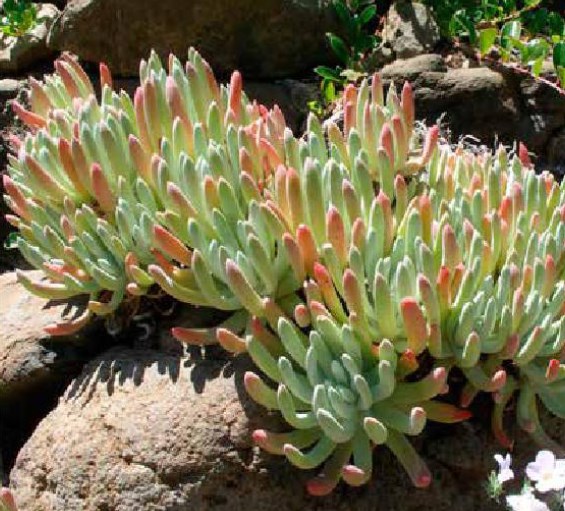
Creating a western garden with mostly natives is a welcome challenge for a designer, but some clients worry that a native landscape will lack drama. That's when I introduce them to the dazzling California succulent, chalk live forever, native to rocky areas of the coastal ranges from San Luis Obispo to northern Baja California. 

With ghostly blue- green foliage coated in chalky white, it's an eye-catching garden accent throughout the seasons. The rosette of nearly two-inch-wide leaves reaches up and out like a fountain, brilliant against ground-carpeting natives with colorful blooms, like the late-winter blue of 'Centennial' California lilac (Ceanothus'Centennial') and the summer-to- fall crimson of ‘Everett's Choice' California fuschia (Epilobium canum ssp. latifollum 'Everett's Choice'].

garden, beautiful, flower
chalk life forever
Dudleya pulverulenta is sensational tucked between rocks, snuggled up against the grand Agave ‘Blue Flame' or combined with other succulents in a container. Best in part shade inland, it dazzles from beneath a cluster of deep wine Aeonium arboretum ‘Zwartkop’ or the nearly black ebony conebush (Leucadendron ‘Ebony’). In late spring, silvery spikes with clusters of orange- red flowers rise up over a foot long.

This distinctive genus also includes tlie stunning Dudleya brittonii, with a sea-green glow to its broad, chalky leaves, and D. caespitosa, with finger-like dumping foliage. Dudleyas are a part of every native garden I design, and I'm always confident my clients will fall in love with these California beauties.

6 Summer Time Leaves Perennials


Brunnera Macrophylla ‘Jack Frost’

Brunnera macrophylla ‘Jack Frost’ Heart-shaped silvered leaves with green veins and rim, plus a spring bonus of blue flowers. Shade loving. 14in (35cm).
ALSO TRY: B. Macrophylla ‘Looking Glass’


Hakonechloa Macra ‘Aureola’
Hakonechloa macra ‘aureola’ Elegant and slow-spreading, with long slender leaves striped in green, yellow and white. 14cm (35cm).
ALSO TRY: Hakonechloa macra ‘Allgold’


Heuchera ‘Caramel’
Heuchera ‘Caramel’ Slightly downy, lobed evergreen foliage in amber, apricot, caramel, yellowish green or red, with red undersides to leaves. 14in (35cm).
ALSO TRY: Heuchera ‘Citronelle’


Hosta ‘Christmas tree’

Hosta ‘Christmas tree’ Slightly ruffled,heart-shaped green leaves edged in yellow that fades to white later. makes an impressive clump. 22in (55cm).
ALSO TRY: Hosta ‘Sum and Substance’


Ophiopogon Planiscapus ‘nigrescens’

Ophiopogon Planiscapus ‘nigrescens’ Slow spreader with long, slender uniquely black evergreen foliage. Looks great against gravel. 8in (20cm).
ALSO TRY: O. planiscapus ‘Black Beard’


Pulmonaria ‘maJesté’


Pulmonaria ‘maJesté’ Shimmering foliage is almost completely silvered, except for a green central vein. At its best when the soil does not dry out. 10in (25cm).
ALSO TRY: Pulmonaria ‘moonshine’


GOOD CARE IN FOLIAGE PERENNIALS
Usually evergreens, notably on pots and pans, will be able to enjoy some cosmetic dental treatment through secateurs and your kitchen scissors

and Have a shot at so herbs don’t frizz simply because it might contribute to ones own foliage in becoming torn and even not as much superb rather than you’d enjoy.
and An intermittent dosage in dissolved rss feed on new season and even ahead of time the summer season can assist that renders start looking their finest.
and Don’t help taller neighborhood friends to help you show up on more compact foliage herbs and even cover ones own colorations.


FOLIAGE DESIGNED FOR POTS AND PANS


FOLIAGE DESIGNED FOR POTS AND PANS
Ajuga, hedera and even heuchera try to make very good spouses designed for keepers

A NUMBER OF FOLIAGE perennials that can be within ones own pinnacle with the summer season try to make fi ne compartment herbs -- regardless if implemented simply because example of beauty herbs on man or woman pots and pans and within the an important different the correct way on much bigger keepers. Brunneras, hakonechloas, heucheras, hostas, ophiopogons and a lot more get bigger clearly on terracotta and cosmetic keepers; choose to shrub one example of beauty at a cookware and shrub three or more at a much bigger cookware. Large hostas, get hold of, might most likely make spectacular includes once three or more herbs can be grown up at a sizeable compartment at which they will likely soon enough merge and appearance to provide a particular grown up shrub.

CREATE A POND IN A POT


A barrel makes a perfect pond for a patio display
   
Nymphaea odorata var. minor has fragrant star-shaped white flowers with golden stamens


IF YOU only have a little pond or you plan to construct a tiny pond out of a tub or barrel, it is wise to opt for one of the dwarf waterlily cultivars instead. For instance ‘Pygmaea Rubra’ (a cheery pink form) will only spread to 18in (45cm) and the amber ‘Aurora’ (bred by Latour- Marliac in 1895) reaches just 12in
(30cm) across. The great advantage of cultivating waterlilies in a little pond or tub is their closeness. While those with vast ponds must walk across planks propped up on the banks or sail out in boats to tend their plants, in a little pool they are easily accessible, making division and cleaning easy. Not to mention, they are also much easier to admire and to sniff!

PLANTING TIPS:


■ Purchase a waterproofed wooden barrel or tub or line it with a PVC pond liner and place it in an open, level, sunny spot.
■ Fill with water – ideally rainwater. If you have to use tap water, leave it in an open container for a few days to allow the chlorine to dissipate.
■ Submerge bunches of oxygenating plants to ensure the water stays clear and pure and consider adding marginals, such as Iris versicolor or Caltha palustris, for extra interest.


                  4 Pygmies for pots

‘Pygmaea Helvola’

Bred by monet’s supplier Latour-marliac, has primrose yellow flowers. Depth 4-8in (10-20cm), spread 12in (30cm) AGm


‘aurora’

true to its name, this form blushes through shades of pink and apricot as it ages. Depth 6-12in (15-30cm), spread 12in (30cm)


‘Ellisiana’

A carmine pink waterlily with starry blooms that flush red as they mature. Depth 6-12in (15-30cm), spread 24in (60cm)


‘PygmaEa RubRa’

Ideal for the uK, this small pink-red form loves cool conditions! Depth 6-12in (15-30cm), spread 18in (45cm)

6 plants in the room Love in Darkness


After a long search I found a plant that will eventually adorn the hallway in front of my house:
Aspidistra
Aspidistra
1. The aspidistra, usually plants known as Cast Iron, has graced multiple workspaces. Many gardening experts describe the aspidistra as one of the toughest and most house plants adaptable. Leaves are shaped like long slender blades dark green and dark green or variegated white, straight out of the soil but in clumps and up to 75 cm and 15 cm wide. This plant is very easy to take care of him but it looks sweet. The plant is also only need minimal light, average temperature and  watering once a week.

The Lost Language of Flowers and Foliage


In the mid 1800s, when someone created a bouquet, they created a message too. The message wasn't written in a letter or on a card, but in the flowers and foliage that made up the bouquet.

For the educated at that time, flowers and foliage had assigned meanings. So the combinations used to make bouquets conveyed messages, to be read only by others in-the-know.

The mythical origins of the language explains that they came from Turkey where a French painter wooed a Harem girl. He took her back to France as his wife where she taught European women to speak with flowers and foliage to their lovers. The Europeans then taught everyone else.

Some plant meanings are obvious, like the Venus' Fly-Trap signifying deceit and danger. Ouch! And a Lemon Branch meaning zest or vigor. Zing!

Some meanings are obvious if you know the Latin name for the flower, like the Daffodil. In Latin it's called a Narcissus, named for the vain god. The Daffodil signifies egotism.

The more interesting are the counter-intuitive ones, like a Cactus symbolizing warmth. But if you think about it, the Cactus grows in a warm climate. The prickliness is ignored.

It's interesting to note that some meanings are different than meanings we commonly accept today, such as for the Shamrock. It does not symbolize luck, but instead means lightheartedness.

And the holiday-season favorite, Mistletoe, does not mean a kiss, but instead means "I surmount difficulties". Perhaps the difficulty surmounted is how to get a certain person to let you kiss them, or how to get a certain person to kiss you? Just a thought...

One plant meaning is still commonly known. The Olive Branch is the universal symbol of peace. And you do still hear people say someone is as solid as an Oak. The Oak symbolizes bravery.

While the language of flowers and foliage is a dead language today, the dictionaries for this language still exist and inspire the more romantic, or devious, among us. If that includes you, here are some suggestions.

  • A bride's bouquet of Blue Violets and Forget-Me-Nots surrounded by Ivy promises a faithful and true love within marriage.
  • A Cabbage Rose and Lupines sent ahead by a date means the person will arrive as an ambassador of love, voracious for your company.
  • You could head off the ambassador with a bouquet of Orange Blossoms and Acacia Leaves declaring your chastity (with them) and offering friendship instead.
  • If you receive Variegated Tulips with Peonies it could be you have an admirer of your beautiful eyes who's too bashful to tell you in person.
  • Watch out for an Oleander Branch with Lavender around a Tuberose. Someone could be trying to tell you to beware and to distrust dangerous pleasures.
  • But Hollyhock with Sweet-Peas means someone has ambitions for delicate pleasures.
  • A sweet arrangement is Buttercups with Daisies and Magnolia, communicating a childish, innocent, love of nature.
  • Even sweeter is Honeysuckle, meaning generous and devoted affection.
  • At a time of loss, Pansies with either Red Poppies, Marigolds or Pine Branches tell a person of your thoughts for them of consolation, despair and pity.
  • But if the person mourning responds with Mimosa and Elm branches, they're telling you they're still sensitive yet coping with dignity.
  • Decorating your doorway with Oak Branches would signify your hospitality to your party guests as they arrive.
  • And a gift bouquet for your party host of Sweet Basil, Parsley, Mint, and Sage will not only make the food more flavorful, but also send good wishes for the festivity, and praises the host for their virtue, especially their domestic virtues.
  • The earthy combination of Grass and Wheat stocks means there's to be a submission with an expectation of great riches.
  • But for the broken heart, try sending the heart-breaker some Lettuce Leaves with Hydrangeas and one White Rose Bud. If they understand the language of flowers and foliage, they'll know you consider them a cold-hearted, boaster who's heart is ignorant of love.

I'll leave you with an Oak leaf with an Olive Branch, or the wish that you're brave enough to seek peace where you now have strife.

How to Make Adenium Rapid Flowering


There are many ways to make quick Adenium rapid flowering.So that the beautiful garden.
I have the
tricks themselves. I think so Adenium fast flowering, the medium needs to. Not enough sand use only, need to use the media layer.
Bottom layer: consists of styroform approximately one third of the pot contents. The goal is to be smooth drainage. Layer in the given the top media consisting of sand, soil, and biokoko, plus NPK fertilizer grain shape. The material is mixed until evenly distributed. Fill in the pot, not fully.Adenium ready to be planted on the media. NPK fertilizer grain again. As the top layer, let the pot full of soil. After planting, flush adenium with water. Put in the shade, during the week. After growth, place in the sun directly. Media need to be replaced regularly. When the media has begun to hard and not fertile, replace immediately. Sign, and the plants grow short not flower. If it is so, the media must be demolished. Watch full pests that attack roots. For example flyblow beetle, dog land, and others. This pest can spend the root, while the plant still appears intact. If it is so, perforce media also must be dismantled.